What you’ll take away.
A reply-handling agreement that records the conversation, the next owner, and the conditions for stopping outreach.
Read the reply in its full context
Read the incoming message together with the subject and previous thread. A short answer can be interest, a question, a referral, or a request to stop. Do not route it from a keyword alone. If a classifier or assistant suggests a category, treat that as an aid to review rather than a reason to ignore the person's actual words.
- Keep the original conversation available to the reviewer.
- Separate human replies from automated notices where possible.
- Pause the scheduled sequence while a human reply is reviewed.
Use a small set of useful states
Choose states that help someone decide what to do next. For example: question to answer, interested conversation, referral to review, out-of-office follow-up, request to stop, and unresolved. Keep classification separate from a sales-stage decision. A person asking about scope has not necessarily agreed to a meeting or a purchase.
- Define each state in plain language.
- Give uncertain cases an explicit review state.
- Preserve a short reason for any change of owner or status.
Make the handoff actionable
A handoff needs more than a new assignee. Record what the person asked, what has been promised, the next action, and who owns it. Link to the original thread instead of copying unnecessary personal information into several systems. Agree on an internal review time that your team can actually meet.
- Name a single next owner and a fallback reviewer.
- Record the next action and due date.
- Carry only the context needed to answer the person well.
Make stop requests travel with the record
A request to stop must change future sending decisions, not just close one inbox item. Define how suppression reaches the campaign, imports, and any connected workflow. Check the result when tools or owners change. A reply-handling note is not a substitute for the actual stop control in the sending system.
- Stop further outreach when requested and retain the necessary suppression record.
- Check for duplicate records before a new campaign or import.
- Review unresolved handoffs so conversations do not stay unowned.
An illustrative handoff note
Reply: the recipient asks whether the outline includes an ownership map. State: question to answer. Owner: the colleague responsible for the outline. Next action: answer the scope question before proposing another step. Context: original thread linked; no additional claims recorded. Sending: automated follow-ups paused during review.
This fictional note demonstrates a question-to-owner handoff. Keep the original thread and review the next action before responding.
The review checklist.
- The reviewer can read the original thread.
- Human replies pause scheduled outreach for review.
- Reply states have plain-language definitions.
- Uncertain replies have an owner and review state.
- Every handoff includes a next action and due date.
- A fallback owner covers absences or missed reviews.
- Stop requests reach suppression controls and future imports.
- The team checks unresolved conversations regularly.
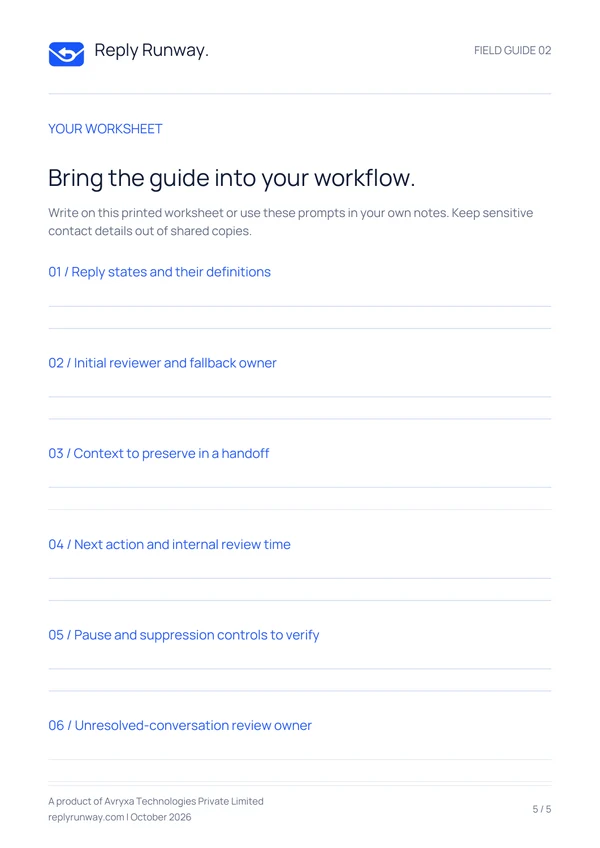
A worksheet for the work ahead.
Use these prompts with your team. The PDF includes space to write your answers.
- Reply states and their definitions
- Initial reviewer and fallback owner
- Context to preserve in a handoff
- Next action and internal review time
- Pause and suppression controls to verify
- Unresolved-conversation review owner
Preview the printable worksheet