What you’ll take away.
A review note with a defined measurement window, clearly labeled counts, a reply theme, and one next test.
Define the question before opening the report
Choose the decision the review should support. You might want to understand whether the offer is clear, whether replies reach the right owner, or whether a particular audience asks the same scope question. A list of rates without a decision can encourage arbitrary changes instead of useful learning.
- Name the campaign, audience, offer, and review period.
- Record whether the unit is messages, contacts, or conversations.
- Choose a comparison group with similar context when one is available.
Keep the denominator visible
Write every rate as a numerator divided by a denominator, with the time window beside it. Our free calculator uses unique replies divided by delivered messages for reply rate, bounced messages divided by sent messages for bounce rate, and unique clicks divided by unique opens for click-to-open rate. Other reports may define these differently, so compare definitions before comparing values.
- Use unique counts for engagement rates.
- Do not mix sent-message and delivered-message denominators.
- Treat missing, zero, or inconsistent counts as review issues rather than successful results.
Read quality alongside quantity
Review reply content in separate categories such as questions, interest, referrals, objections, and stop requests. A reply is not automatically a positive outcome. Open and click signals can be affected by privacy features and automated activity. Keep the limitations beside the interpretation, and use conversations and qualified next steps to add context.
- Separate positive interest from total replies.
- Record recurring questions in the recipient's own terms without unnecessary personal details.
- Review handoff quality and requests to stop alongside campaign activity.
Write one next test
Turn the review into a hypothesis with a change, an owner, and a review date. Avoid changing audience, offer, timing, and copy at the same time if you want to understand what helped. Small samples fluctuate and a single comparison does not prove causation. Record what you observed and what remains uncertain.
- Keep the comparison window and definitions consistent.
- Choose one meaningful variable to change.
- Document the decision and revisit it with fresh evidence.
An illustrative measurement note
Counts: 200 delivered messages and 12 unique replies. Defined reply rate: 12 / 200 x 100 = 6%. Conversation review: four replies ask what the outline includes. Hypothesis: a clearer deliverable description may reduce scope questions. Next test: revise that description while keeping the audience and review window comparable.
These are fictional counts for explaining the calculation, not industry benchmarks or a forecast of future results.
The review checklist.
- The review question and date range are explicit.
- Audience, offer, and comparison context are recorded.
- Every rate has a numerator, denominator, and unit.
- Engagement counts are unique and internally consistent.
- Open/click limitations are included in the interpretation.
- Positive interest is separated from total replies.
- Reply themes and handoff issues are recorded.
- One next test has an owner, a change, and a review date.
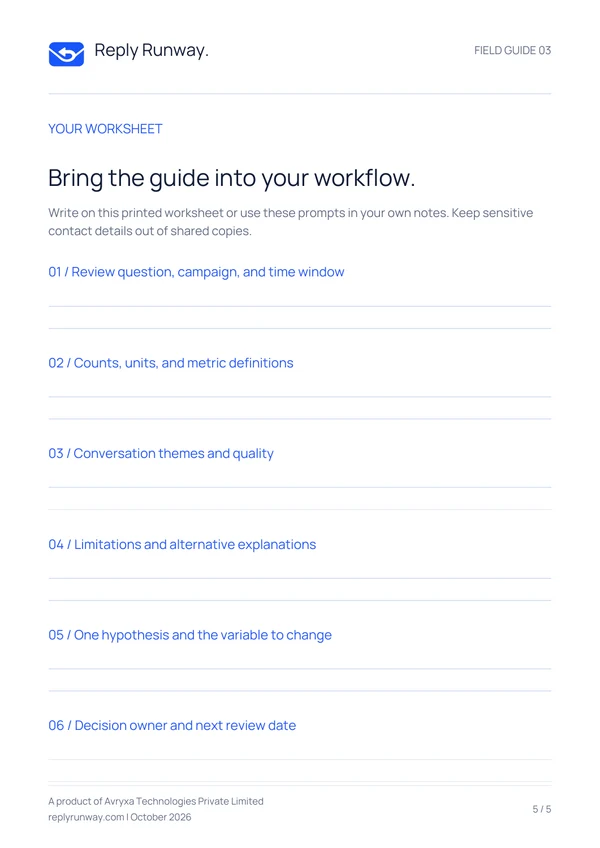
A worksheet for the work ahead.
Use these prompts with your team. The PDF includes space to write your answers.
- Review question, campaign, and time window
- Counts, units, and metric definitions
- Conversation themes and quality
- Limitations and alternative explanations
- One hypothesis and the variable to change
- Decision owner and next review date
Preview the printable worksheet