What you’ll take away.
A campaign brief with evidence, an agreed message, clear stop conditions, and a review owner.
Define who belongs in the campaign
Choose a role, company context, and problem that make the same offer relevant to the group. Record why a person fits before writing their introduction. A broad industry category can hide very different needs; a specific situation gives your team something to verify.
- Write a one-sentence audience definition.
- Record the source and date for each relevant observation.
- Exclude previous opt-outs, existing customers where inappropriate, and records without a clear fit.
Separate the observation from the offer
Keep verified facts and assumptions in different parts of the brief. A public hiring notice can show that a company is advertising a role; it does not prove a process is broken. Explain what you can offer without pretending that you have already reviewed the recipient's business.
- Choose one concrete deliverable or outcome to discuss.
- Attach evidence to any result, customer name, or other claim.
- Remove invented familiarity, urgency, and unsupported comparisons.
Review the sequence as one conversation
Give each touch a distinct contribution. The first email can introduce an idea, a follow-up can clarify scope, and a closing message can end the sequence respectfully. Choose intervals with the recipient's context in mind. Repetition is not the same as useful follow-up.
- Keep one primary question in each message.
- Resolve all variables and test links in the final copy.
- Review what happens on a human reply, bounce, or request to stop.
Agree on ownership and the first review
Name the person who approves the audience and copy, the person who handles replies, and the person who reviews results. Decide which counts will be collected and when you will compare them. An owner and a decision date make a brief usable after the writing is finished.
- Record the account and sending-setup owner.
- Check authentication and provider configuration with the relevant administrator.
- Choose one hypothesis to review rather than changing everything at once.
An illustrative campaign brief
Audience: customer-success leads at small software teams with a verified public onboarding hiring signal. Offer: a short outline for documenting handoff steps and ownership. First question: would that outline be useful? Follow-up: clarify what the outline covers. Stop: pause for human replies and suppress requests to stop. Review: examine reply themes before changing the offer.
This fictional brief keeps the audience, offer, and response handling explicit. Adapt each part to your own verified context.
The review checklist.
- The audience definition is specific and exclusions are recorded.
- Every personalized observation has a source and date.
- Claims and any named proof have been checked.
- Each message has one purpose and a clear question.
- Names, placeholders, links, and the full thread have been reviewed.
- Sending setup and account ownership have been checked.
- Reply handling, bounce handling, and stop rules have owners.
- The review date, definitions, and first hypothesis are written down.
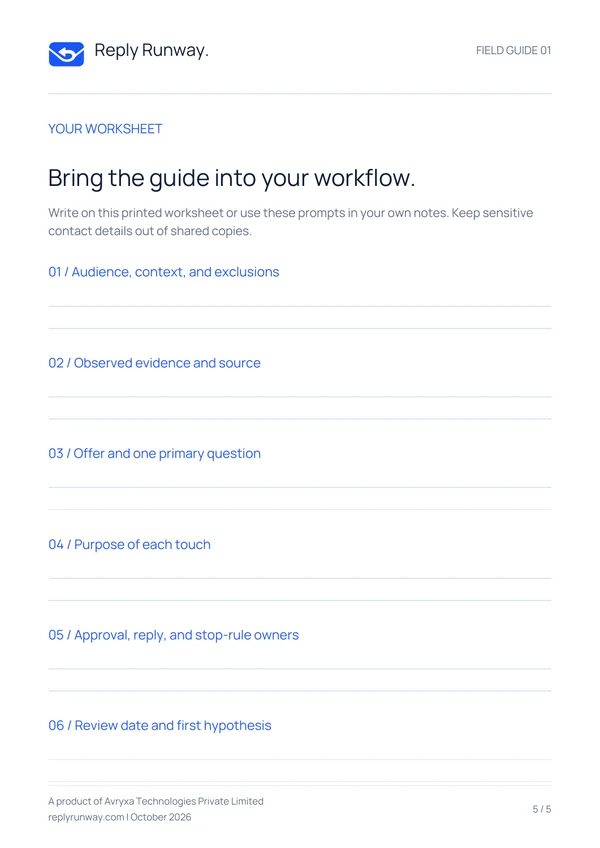
A worksheet for the work ahead.
Use these prompts with your team. The PDF includes space to write your answers.
- Audience, context, and exclusions
- Observed evidence and source
- Offer and one primary question
- Purpose of each touch
- Approval, reply, and stop-rule owners
- Review date and first hypothesis
Preview the printable worksheet